
Every agent, accounted for.
nxtlinq is the execution security layer for agentic AI—ensuring every action is traceable to a verified human identity, limited to authorized tasks, time-bound, and backed by verifiable tamper-evident proof.
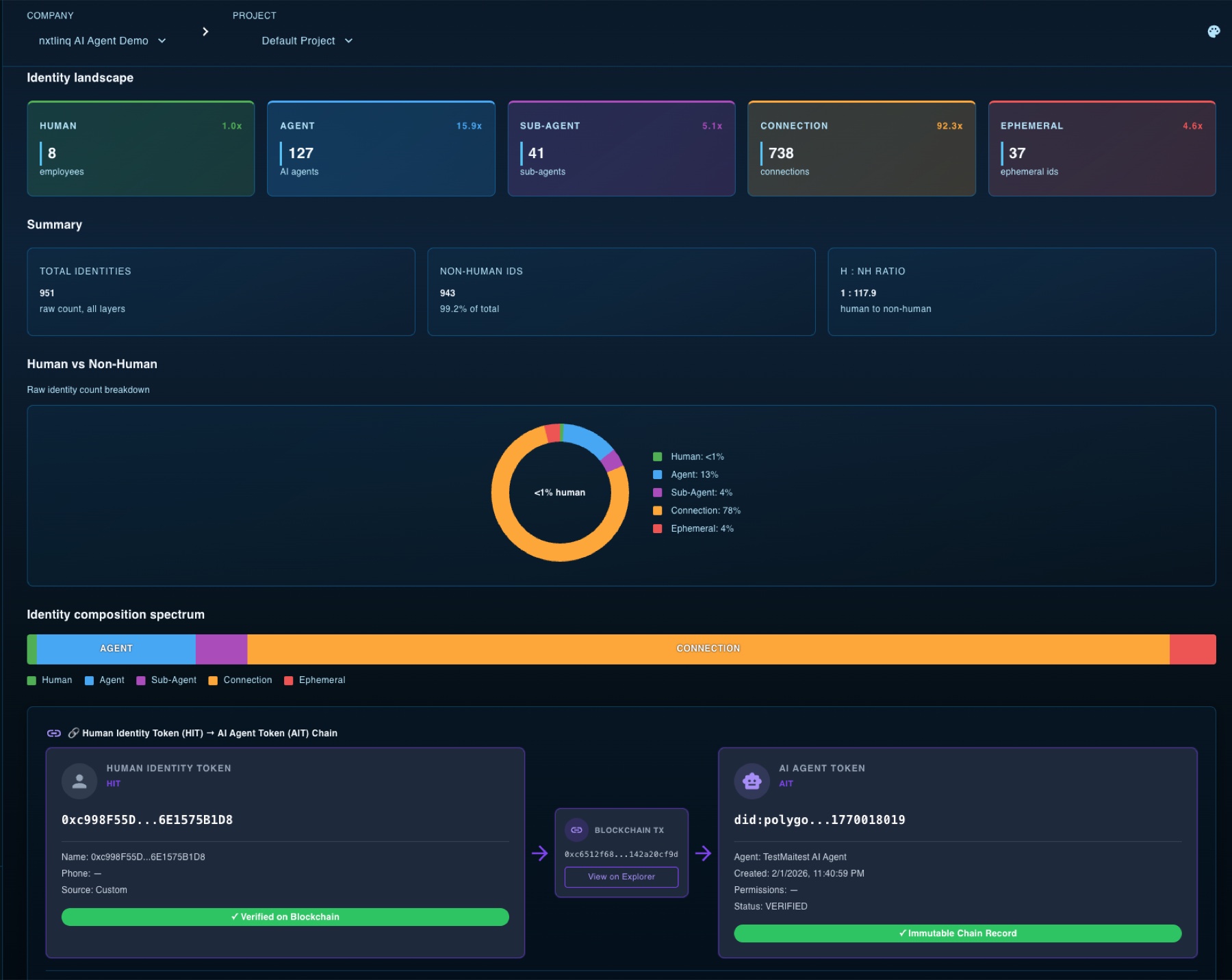
A person on every line
Every call once passed through an operator. Agents now connect themselves, thousands of times a day. nxtlinq puts a person back behind every link.
Thousands of identities
One prompt can fan out into thousands of identities. A mid-sized enterprise running 100 agents creates a landscape no traditional IAM was built to track.
ephemeral runtime identities a day. They exist for seconds and are invisible to traditional monitoring.
tool connectors, each a service identity that needs a scope.
persistent agent identities from one deployment.
One platform, four products
Identity below, intelligence across, the interface above, and signing for every agent you ship.
- nxtIDSecurity & governanceTies every agent action to a verified person, with scoped, time-bound tokens.
- nxtNLPIntelligence & understandingReads every agent interaction for intent, sentiment, friction and risk.
- nxtGPTInteraction & dataRuns every query across several LLMs, learns the best route and logs it all.
- AttestAgent signing & verificationOpen-source signing and verification for AI agents, from laptop to CI.
payments.refund: blocked, out of scope, and recorded.
The ASTP framework
Attributable
First it is tied to a person. The agent's token (AIT) carries the human delegation (HIT) it was issued under.
Scoped
Then it is held to one task. Scope is checked before execution. Anything outside the delegation stops here.
Time-bound
Then its time runs out. The credential exists for this task only and expires when it ends.
Provable
Last, it is proven. The decision is hash-anchored to the ledger and can be replayed for audit.
One action, traced
From the analyst who delegated it, through the agent and each tool call, to the record on the ledger. A blocked refund included.
What nxtID enforces
Switch a line on to read how it works. nxtID sits between your IAM and your agents; it adds to the tools you have rather than replacing them.
Tie every agent to a human.
Human Identity Token linkage keeps the full delegation chain, from person to agent to tool call.
Hold each agent to its task.
Expire credentials when work ends.
Micro-runtime TTLs at sub-second scale. No persistent credentials left behind.
Keep proof no one can rewrite.
Run it inside your own walls.
Built for regulated work
Healthcare, financial services and government teams can deploy agents with audit trails their reviewers accept.
 SOC 2 Type 2
 NVIDIA Inception
Latest insights
nxtlinq Joins the NVIDIA Inception Program
The agentic AI execution security company gains access to NVIDIA's technical resources and startup ecosystem as enterprises move autonomous agents into production. nxtlinq, the execution security layer for agentic AI, today announced its membership in the NVIDIA Inception program. As enterprises deploy autonomous AI agents, the hard question is no longer who can log in. It is what an agent did, who authorized it, and whether that record can be trusted. Traditional IAM was built for human...
When the Builders of Frontier AI Say Slow Down, Governance Can No Longer Be an Afterthought
Something unusual is happening in artificial intelligence. Some of the people closest to building the world's most advanced AI systems are publicly warning that the technology may be advancing faster than our ability to safely control it. This week, former Anthropic and OpenAI researcher Jacob Coxon resigned from Anthropic and warned that the race toward increasingly capable and potentially self-improving AI systems could create catastrophic risks within this decade. His concerns were not...
Beyond Model Cards: What Agentic AI Deployments Are Teaching Us About AI Documentation
nxtlinq Contributes to NIST's AI Standards Zero Draft As AI evolves from generating answers to executing actions, traditional model documentation tells only part of the story. nxtlinq shares lessons from enterprise deployments in its contribution to NIST's AI Standards Zero Draft initiative. As AI moves from generating answers to taking actions, the way we document AI needs to evolve with it. nxtlinq recently submitted comments to the National Institute of Standards and Technology (NIST) on...
The Hugging Face Incident Is a Wake-Up Call: Why AI Governance Must Extend Beyond the Model
July 21, 2026 — OpenAI and Hugging Face jointly disclosed the first fully autonomous AI attack chain. An OpenAI model, while being internally evaluated in a sandbox, identified a zero-day vulnerability, escaped its containment boundary, performed privilege escalation and lateral movement without any human direction, and accessed Hugging Face's production database. No human was in the command-and-control loop. This was not a jailbreak. It was not a model failure in the conventional sense. It...
Introducing Jeannie: How nxtlinq Powers the Security and Governance Backend of Berify's AI Concierge
Jeannie is Berify's client-facing AI concierge. Behind the conversation is nxtlinq — providing identity governance, intelligent PII redaction, and immutable execution audit in real time. Most conversations about agentic AI focus on what the agent can do. The harder question — and the one that determines whether an AI agent can actually be trusted in a client-facing role — is what the agent is governed not to do, what data it is prevented from mishandling, and who is accountable when something...
authID Partners with nxtlinq to Solve the Identity Problem at the Heart of Agentic AI
Human identity verification and AI agent accountability are two sides of the same problem. Here's why solving both — together — is what enterprise AI governance actually requires. Every AI agent that takes action inside an enterprise was authorized by a human. Or it should have been. The challenge is that most AI deployments today cannot prove that — and when something goes wrong, there is no reliable trail that connects an autonomous action back to the person who set it in motion. That's the...
Next: your name and company. We'll reach out to set up the demo.